
1938.RUS.01Children of the USSR — Artek and young inventors
 Russia·1938
Commemorative series Children of the USSR, September 1938
Series details
Identity
- CodeSeries code YYYY.ENT.SS — year, 3-letter issuing entity, sequence (e.g. 1900.CGH.01).
1938.RUS.01- EntityPostal authority that issued the stamps (country, territory, or historical entity).
- Russia (RUS)
- Year
- 1938-09-16
- Event
- Commemorative series Children of the USSR, September 1938
- TypeIssue kind. Charity issue = postage + voluntary surcharge (e.g. 6+4), not an overprint.
- Commemorative
Production
- Process
- Typography
- PerforationsHole gauge between stamps (e.g. 12, 13½). Higher ≈ finer.
- Comb 11¾ × 12¼
Catalog numbers
- ScottScott catalog number (Americas).
- SU 662; SU 664; SU 665
- MichelMichel catalog number (Europe / DE).
- SU 621; SU 623; SU 624
- YvertYvert & Tellier catalog number (FR).
- SU 654; SU 656; SU 657
- Stanley GibbonsStanley Gibbons catalog number (UK / Commonwealth).
- SU 794; SU 796; SU 797
History
The Soviet Union issued the series Children of the USSR on 16 September 1938, seven values showing Soviet childhood at its most photogenic. Three of them belong to the youth-movement theme and are catalogued here; the other four are recorded below as non-scout companions from the same set.
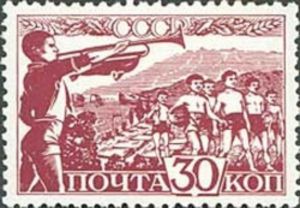
The 30 kopek red-lilac shows the Pioneer camp at Artek, and that is the significant one. Artek opened in 1925 on the Black Sea below Ayu-Dag, the Bear Mountain of the Crimea, as a tent camp for children with tuberculosis, and grew into the flagship of the Pioneer movement — the reward camp, the one whose name every Soviet child knew, host to foreign delegations and to the model of what Pioneer life was supposed to look like. Ivan Dubasov drew it: an instructor with outstretched arm addressing a line of children on the shore, the hills behind.
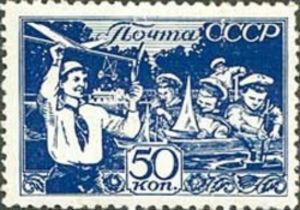
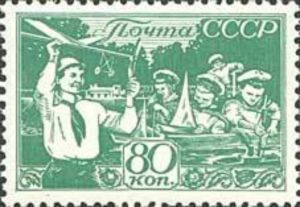
The 50 kopek blue and the 80 kopek light green share one design by Sergei A. Pomansky — a boy launching a model glider while others crouch over model yachts at the water's edge. Model aviation and model sailing were organised Pioneer activities, run through the technical circles that the movement maintained alongside its camps.
All three are typographed on chalky paper, 37 × 26 mm, comb perforation 11¾ × 12¼, without watermark, in sheets of 50. Printings were 1,200,000 of the 30 kopek and 1,000,000 of each of the other two. Beyond the main catalogues the stamps are listed as AFA SU 628–631, Soloviev 609–612 and Zagorsky 522–525.