
1959.DNK.0150th anniversary of Det Danske Spejderkorps
 Denmark·1959
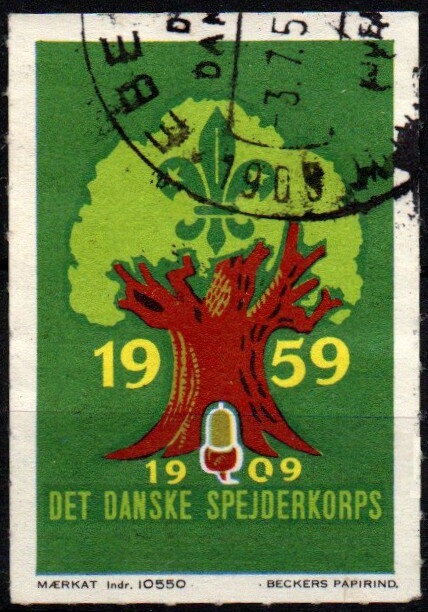
Charity label for the fiftieth anniversary of Det Danske Spejderkorps, the Danish Scout Corps, 1959
Series details
Identity
- CodeSeries code YYYY.ENT.SS — year, 3-letter issuing entity, sequence (e.g. 1900.CGH.01).
1959.DNK.01- EntityPostal authority that issued the stamps (country, territory, or historical entity).
- Denmark (DNK)
- Year
- 1959
- Event
- Charity label for the fiftieth anniversary of Det Danske Spejderkorps, the Danish Scout Corps, 1959
- TypeIssue kind. Charity issue = postage + voluntary surcharge (e.g. 6+4), not an overprint.
- Cinderella
Production
- Printer
- Beckers Papirindustri
- Process
- Lithography
History
A jubilee label — mærkat in Danish — issued in 1959 for the fiftieth anniversary of Det Danske Spejderkorps, the Danish Scout Corps. It carries no face value and no catalogue number: this is a cinderella, sold to raise funds and to be stuck on correspondence beside the postage, and the copy held here is cancelled, so it was used that way.
The design is an oak with a red trunk rising against a pale green canopy in which the Scout fleur-de-lis is set, the year 1959 in yellow to either side of the trunk and 1909 on an acorn at its foot, with DET DANSKE SPEJDERKORPS along the base. The lower margin carries the producer's imprint, MÆRKAT Indr. 10550 · BECKERS PAPIRIND., for Beckers Papirindustri.
The two dates need a word of explanation. Det Danske Spejderkorps was formally constituted on 16 December 1910, but the corps has always counted its founding from 19 November 1909, when Scouting was first organised in Denmark — so 1959 was its jubilee year rather than 1960.
Colnect files this label under a broad heading for the St. George's Guild in Denmark, which collects Danish Scout and Guide labels of many kinds; the label itself names the Scout Corps, and it is catalogued here under that. It joins the run of Danish cinderellas already in the catalogue, from the Carl Lønberg advertising label of 1913 through the camp-fund labels of 1920 and the Sct. Georgs-gilderne label of 1930.