
K.F.U.K.s Spejdere — 5 øre (first aid)
Piece details
Identity
- Piece codeStamp code YYYY.ENT.SS-PP — series code plus stamp order (e.g. 1900.CGH.01-02).
1922.DNK.01-01- SeriesThe set this stamp belongs to.
- K.F.U.K.s Spejdere
1922.DNK.01· piece 1 of 1 - EntityPostal authority that issued the stamps (country, territory, or historical entity).
 Denmark (DNK)
- Year / date
- 1922
- Face valueDenomination on the stamp; +n is a charity surcharge when present.
- 5 øre
- Format
- Stamp
- TypeIssue kind. Charity issue = postage + voluntary surcharge (e.g. 6+4), not an overprint.
- Cinderella
- Colors
- Green
- CollectionIn collection if you have it; Purchased if it is bought but not yet received (do not buy again); Wanted otherwise.
- ✓ In collection
Notes
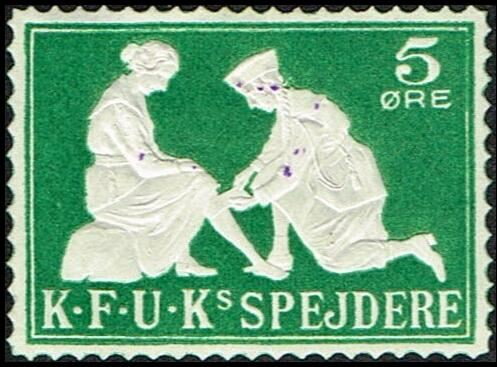
Green perforated label. Two girl Scouts: one bandages the other’s foot. Legend «K.F.U.Ks SPEJDERE»; value «5 ØRE». Fundraising cinderella for the Danish YWCA Girl Scouts.
Series history
The Kristelig Forening for Unge Kvinder (K.F.U.K. — the Danish YWCA) founded its own Scout corps for girls on 4 May 1919: K.F.U.K.s Spejdere (later written KFUK-spejderne i Danmark; from 2003 De grønne pigespejdere — “The Green Girl Guides”). The founder most often named is professorinde Ingrid Ulbricht, with early leadership from gymnastik teacher Augusta “Fryd” Frydendahl and support from KFUM (YMCA) Scout leaders. Girl Scouting in KFUK faced strong internal resistance at first; chairman Countess Henriette Knuth and many local leaders opposed the idea. Nonetheless the movement grew quickly: by Ascension Day 1920 already more than 500 girls were mustered, and in 1922 the corps counted about 1,020 members in 32 troops, launched its own magazine K.F.U.K. SPEJDERNE (15 May 1922), and gained international recognition.
This label is not a postage stamp. It is a green perforated poster stamp (plakatmærke / mærkat) sold for 5 øre to support the young corps. The design shows two girl Scouts in uniform — one kneeling to bandage the other’s foot — a classic first-aid / “samaritan” scene that advertised useful service skills as much as outdoor adventure. The imprint uses the early dotted spelling K.F.U.Ks SPEJDERE, standard until the mid-1930s. Green was already the corps colour (green blouse with blue skirt in the first uniforms), long before the 2003 rename made “green” part of the official name.
Placed only three years after the foundation and two years before Denmark hosted the 2nd World Scout Jamboree (Ermelunden, 1924), the stamp documents how quickly Christian girl Scouting in Denmark built a public identity — and how poster stamps financed and promoted that growth.