
1940.FRA.01War Aid — Marshal Joseph-Simon Gallieni
 France·1940
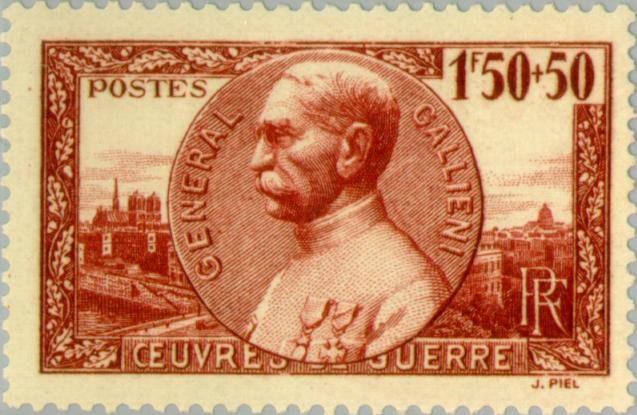
Semi-postal war-charity portrait of Marshal Gallieni; scout connection via the 1911 French Scouting committee
Series details
Identity
- CodeSeries code YYYY.ENT.SS — year, 3-letter issuing entity, sequence (e.g. 1900.CGH.01).
1940.FRA.01- EntityPostal authority that issued the stamps (country, territory, or historical entity).
- France (FRA)
- Year
- 1940-05-01
- Event
- Semi-postal war-charity portrait of Marshal Gallieni; scout connection via the 1911 French Scouting committee
- TypeIssue kind. Charity issue = postage + voluntary surcharge (e.g. 6+4), not an overprint.
- Charity issue
Production
- Designer
- Jules Piel
- Process
- Engraving (engraver Jules Piel)
- PerforationsHole gauge between stamps (e.g. 12, 13½). Higher ≈ finer.
- 13
Catalog numbers
- ScottScott catalog number (Americas).
- FR B99
- MichelMichel catalog number (Europe / DE).
- FR 469
- YvertYvert & Tellier catalog number (FR).
- FR 456
- Stanley GibbonsStanley Gibbons catalog number (UK / Commonwealth).
- FR 664
History
On 1 May 1940 France issued a semi-postal portrait of Marshal Joseph-Simon Gallieni (1849–1916) in the War Charities series: 1.50 francs postage plus 0.50 franc surcharge for war aid. The stamp shows Gallieni in uniform against a Parisian backdrop (including the Arc de Triomphe). Design and engraving by Jules Piel; recess printing; comb perforation 13; size about 40 × 26 mm; sheets of 25; print run about 1.765 million.
Gallieni was a colonial general, military governor of Paris in 1914 (famous for the “taxi-cab” defence that helped check the German advance on the Marne), and later Minister of War. He was raised posthumously to the rank of Marshal of France in 1921. The design itself is a statesman-soldier portrait, not a Scout in uniform.
The stamp enters a Scouts-on-Stamps catalogue for the same biographical reason as the 1933 Paul Doumer issue: in 1911 Gallieni sat on the national committee that helped form and coordinate the French Scout associations (Éclaireurs) in the years when Baden-Powell’s movement was taking root in France. Colnect tags the stamp under the theme Escotismo; the sheet title records him as a member of that 1911 committee. The scouting interest is therefore historical and organisational rather than pictorial.
After the fall of France, the same Gallieni design received local German occupation overprints at Dunkirk (July 1940). Type II is a rectangular frame with a three-line inscription and a straight top. A se-tenant block of four of the basic stamp is shown as optional related display material, not a separate catalog piece.