
Lord Baden-Powell
Piece details
Identity
- Piece codeStamp code YYYY.ENT.SS-PP — series code plus stamp order (e.g. 1900.CGH.01-02).
1900.CGH.01-02- SeriesThe set this stamp belongs to.
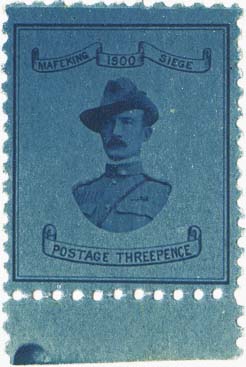
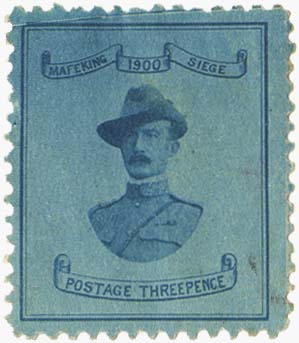
- Mafeking Scout Post
1900.CGH.01· piece 2 of 3 - EntityPostal authority that issued the stamps (country, territory, or historical entity).
 Cape of Good Hope (Mafeking) (CGH)
- Year / date
- 1900-04-06 · earliest reported date
- Face valueDenomination on the stamp; +n is a charity surcharge when present.
- 3 p
- Format
- Stamp
- TypeIssue kind. Charity issue = postage + voluntary surcharge (e.g. 6+4), not an overprint.
- Siege provisional / local post
- Colors
- Blue (ferroprussiate)
- CollectionIn collection if you have it; Purchased if it is bought but not yet received (do not buy again); Wanted otherwise.
- ✓ In collection
Production
- Designer
- Capt. H. Greener
- Printer
- D. Taylor
- Process
- ferroprussiate (blue-print method)
- Paper
- laid batonne paper
- PerforationsHole gauge between stamps (e.g. 12, 13½). Higher ≈ finer.
- 12
- Panes
- 12 stamps
- Quantity printed
- 6,072
Catalog numbers
- DomfilDomfil thematic catalog number (scouting).
- 900.16
- ScottScott catalog number (Americas).
- 179
- MichelMichel catalog number (Europe / DE).
- 16 I
- YvertYvert & Tellier catalog number (FR).
- 22
Notes
Domfil 900.16 · quantity printed: 6,072 · earliest reported date
Series history
During the Second Anglo-Boer War, Boer forces invested the frontier town of Mafeking (today Mafikeng, South Africa) in mid-October 1899. The siege lasted 217 days, until British relief columns broke through on 17 May 1900.
Colonel R.S.S. Baden-Powell commanded the defence. He placed the civil post office under military control so that soldiers and townsfolk ringed in fortified positions could stay in touch with family inside the town — a deliberate measure to sustain morale during a long investment. Early in the siege, the remaining stocks of Cape of Good Hope, British Bechuanaland and Bechuanaland Protectorate stamps held in the post office were bought by the military, then overprinted and surcharged “Mafeking Besieged” (and a new value) by Townshend & Son for special runner rates north and south of the town. Those overprints are ordinary colonial postage stamps with a siege surcharge — not Scout designs.
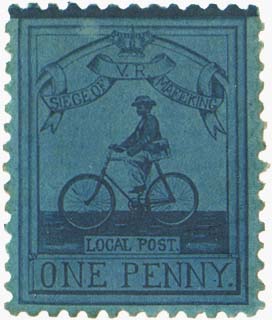
When those overprints ran out in early 1900, Baden-Powell authorised two emergency photographic stamps for purely local use — nicknamed the “Mafeking Blues.” They were produced by the ferroprussiate (blueprint) process on laid batonne paper, printed in small panes by D. Taylor. The 1d shows Cadet Sergeant-Major Warner Goodyear of the Cadet Bicycle Corps, which carried mail between the forts; the design is by Dr. W. A. Hayes. The 3d bears Baden-Powell’s portrait, drawn by Capt. H. Greener, first in a small “head” format (in circulation from about 6 April 1900) and soon after in a larger format (about 10 April), the same day the Goodyear bicycle stamp is generally dated.
The Mafeking Cadet Corps of boys on bicycles, organised for messages and postal runs under fire, is often recalled as a practical forerunner of the scouting spirit. Scouting as a movement was founded only in 1907, yet these siege provisionals — especially the Goodyear and Baden-Powell designs — are widely treated as the classic starting point of Scouts on Stamps collecting. They were intended for local postage within the besieged town; living-person portraits other than the monarch were unusual for British colonial mail of the period.
A contemporary commemorative postcard (Raphael Tuck & Sons Empire series) celebrating the relief of “gallant little Mafeking” is kept with this set as a related piece of siege ephemera. Below the catalogued Scout pieces, optional related images show Bechuanaland (and companion Cape) “Mafeking Besieged” overprints as postal-history context only — they are not numbered scouting catalog pieces.
The American Topical Association’s 1964 handbook (Thorsen & McKinney) records ferro-prussiate production details still useful to collectors: the first Baden-Powell 3d measured about 18½ mm and was soon replaced by a larger about 21 mm format when the cyclist stamp showed better detail; reported print quantities are small-size B-P 6,072, cyclist 9,476 and large B-P 3,036 (Scott 179, 178 and 180). Captain Greener’s B-P design followed a D. Taylor photograph; Dr Will Hayes is credited with retouching the cyclist background, frame and inscriptions. Years later Baden-Powell referred to Cadet Sergeant-Major Warner Goodyear as his first boy Scout — the practical seed of the later movement.