
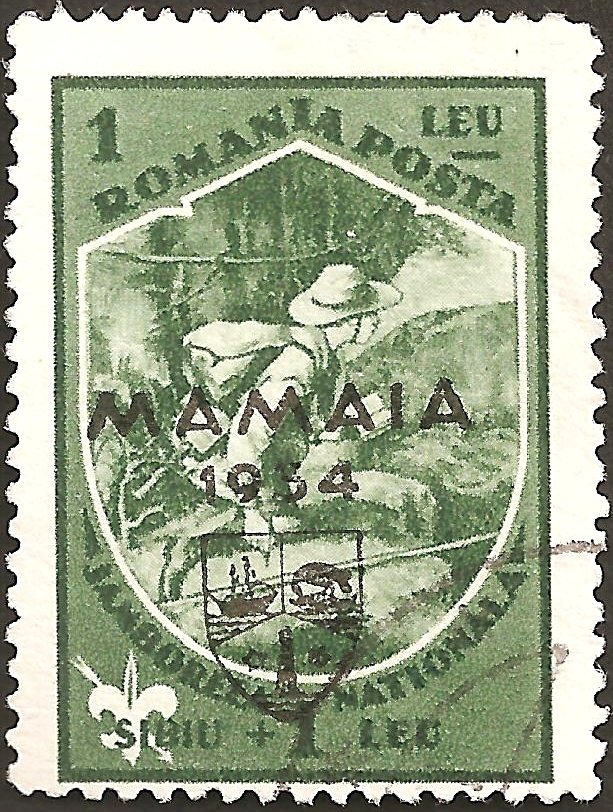
Scout tracking — 1 + 1 lei, Mamaia OP
Piece details
Identity
- Piece codeStamp code YYYY.ENT.SS-PP — series code plus stamp order (e.g. 1900.CGH.01-02).
1934.ROU.01-03- SeriesThe set this stamp belongs to.
- National Boy Scout Jamboree — Mamaia (overprint)
1934.ROU.01· piece 3 of 6 - EntityPostal authority that issued the stamps (country, territory, or historical entity).
 Romania (ROU)
- Year / date
- 1934-07-08
- Face valueDenomination on the stamp; +n is a charity surcharge when present.
- 1 + 1 lei
- Format
- Stamp
- TypeIssue kind. Charity issue = postage + voluntary surcharge (e.g. 6+4), not an overprint.
- Charity issue
- Colors
- Opal green
- CollectionIn collection if you have it; Purchased if it is bought but not yet received (do not buy again); Wanted otherwise.
- ✓ In collection
Production
- PerforationsHole gauge between stamps (e.g. 12, 13½). Higher ≈ finer.
- 13½
- Printing
- Photogravure
Catalog numbers
- DomfilDomfil thematic catalog number (scouting).
- 934.6
- ScottScott catalog number (Americas).
- RO B46
- MichelMichel catalog number (Europe / DE).
- RO 470
- YvertYvert & Tellier catalog number (FR).
- RO 476C
- Stanley GibbonsStanley Gibbons catalog number (UK / Commonwealth).
- RO 1291
Notes
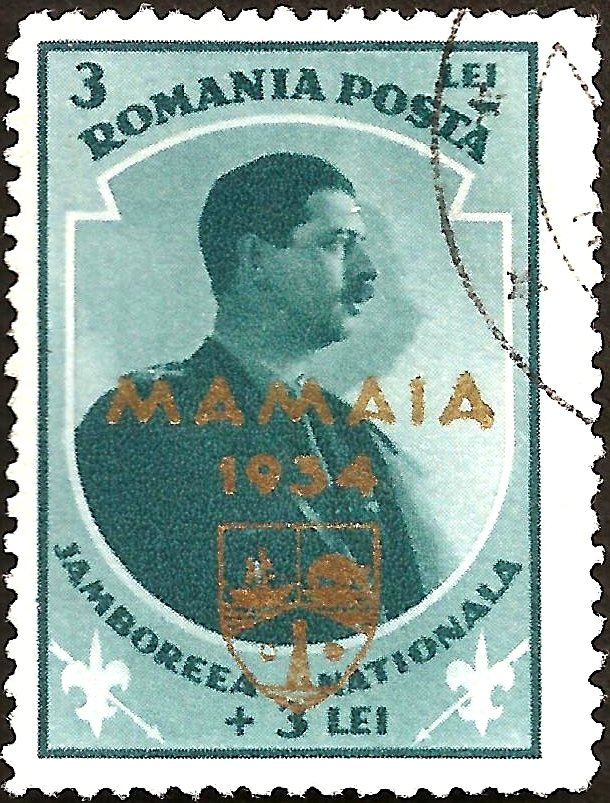
Black overprint «Mamaia 1934» on 1932 B33 (tracking).
Series history
In 1932 Romania had issued a full semi-postal set for the National Boy Scout Jamboree (the designs later catalogued as Scott B31–B36 / Michel 437–442 — camp, signalling, tracking, cooking, King Carol II, and Carol II with Prince Michael). Two years later another national Scout jamboree was held at Mamaia, on the Black Sea coast.
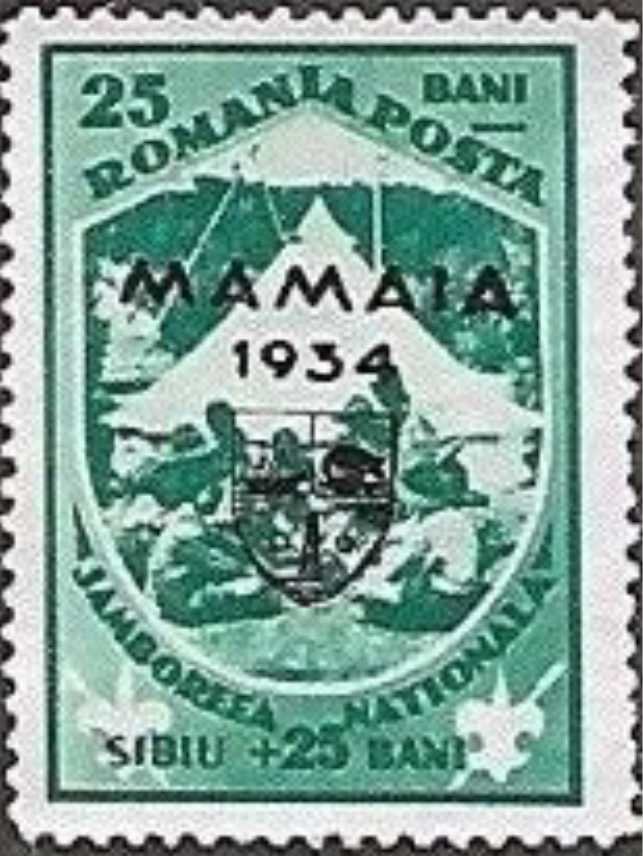
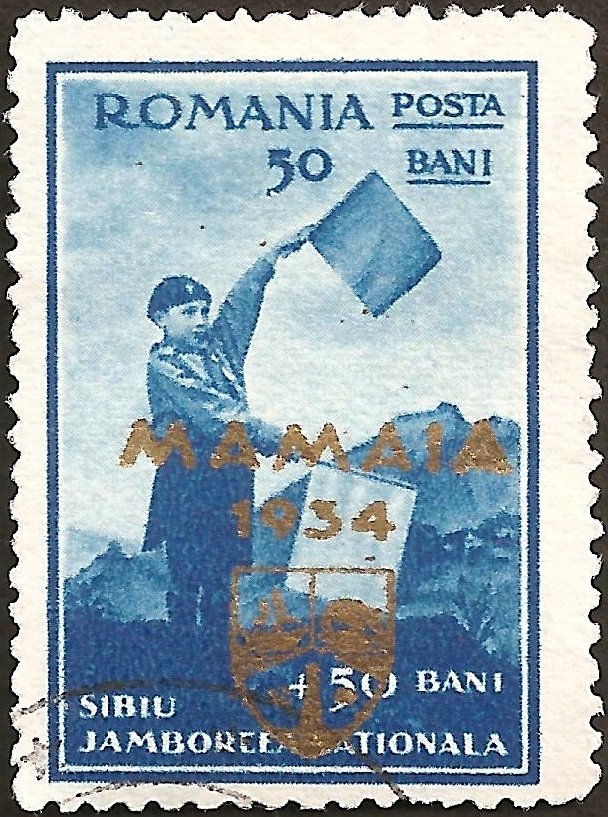
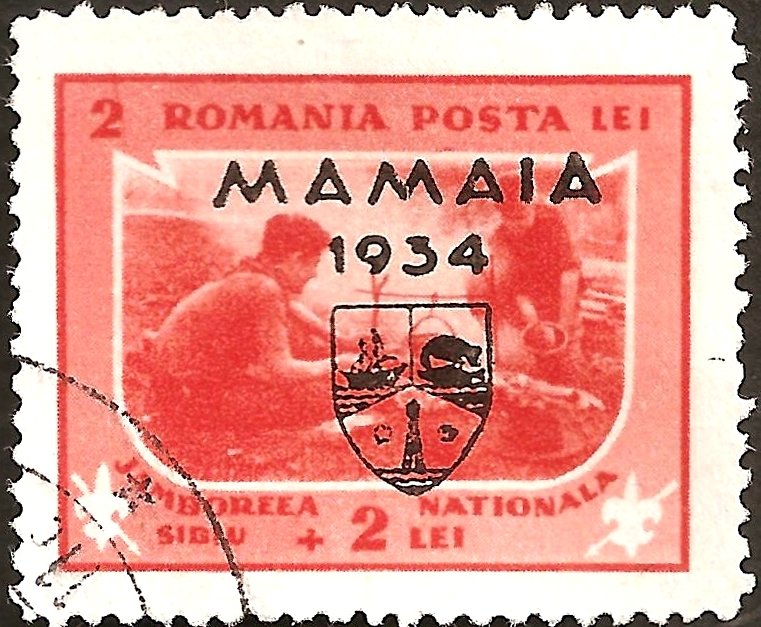
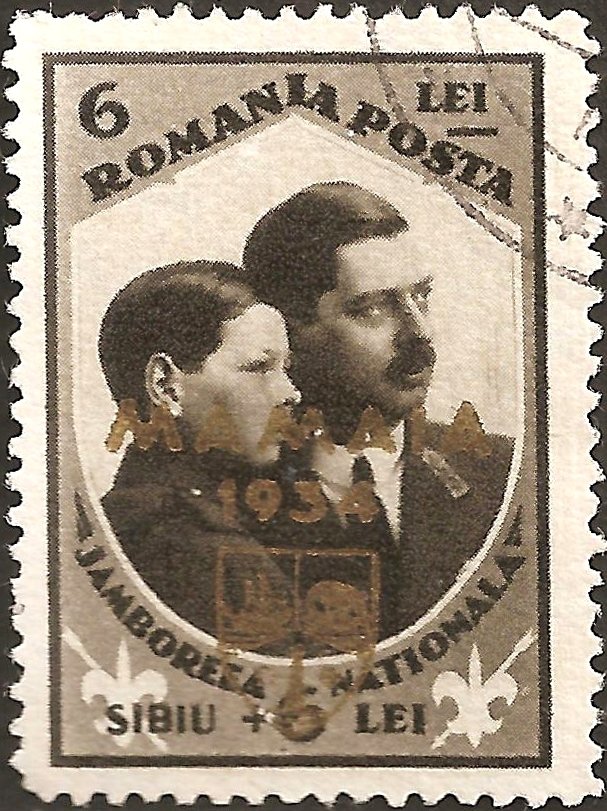
Instead of engraving a new pictorial set, the post simply overprinted remaining stocks of the 1932 designs with «Mamaia 1934». SOSOW records the issue date as 8 July 1934. The overprint is black on three values (the 25+25 bani tent, 1+1 lei tracking, and 2+2 lei cooking) and gold on the other three (50+50 bani signalling, 3+3 lei Carol II, and 6+6 lei Carol II with Michael). Face values and surtax for Scouting stayed the same as in 1932.
Why overprint rather than a new design? It was a quick, economical way to mark the new jamboree and keep the Scout fund surcharge on sale: the 1932 plates and remaining sheets were already in stock, the motifs still read clearly as Scout scenes and royal patronage, and only the place-year needed updating. The same practice appears in many countries when a second event reuses a successful first issue. Catalogue numbers change (Scott B44–B49, Domfil 934.4–934.9) because the overprint creates a distinct emission, even though the underlying engraving is the Sibiu 1932 set. Print run is reported at 50,000 of each value — lower than the original 150,000 of 1932.
Proofs of the overprint in red also exist (SOSOW additional images): red «Mamaia 1934» on the 1 + 1 lei tracking design (issued OP black) and on the 3 + 3 lei Carol II (issued OP gold). Those red proof overprints are catalogued here as Wanted specials, not as the six issued values.
ATA 1964 lists the Mamaia / Brașov overprints on the previous Scout designs: black overprints on 25 b, 1 L and 2 L; gold overprints on 50 b, 3 L and 6 L, for the national Boy Scout Jamboree.