
World Scout emblem and salute

Piece details
Identity
- Piece codeStamp code YYYY.ENT.SS-PP — series code plus stamp order (e.g. 1900.CGH.01-02).
1981.CMR.01-03- SeriesThe set this stamp belongs to.
- 4th African Conference of Scouting, Abidjan
1981.CMR.01· piece 3 of 4 - EntityPostal authority that issued the stamps (country, territory, or historical entity).
 Cameroon (CMR)
- Year / date
- 1981-10-05
- Face valueDenomination on the stamp; +n is a charity surcharge when present.
- 100 f
- Format
- Stamp
- TypeIssue kind. Charity issue = postage + voluntary surcharge (e.g. 6+4), not an overprint.
- Airmail
- Colors
- Multicolour
- CollectionIn collection if you have it; Purchased if it is bought but not yet received (do not buy again); Wanted otherwise.
- ○ Wanted
Production
- Designer
- Louis-Marie Lemana
- Printer
- Cartor
- Process
- Offset lithography
- PerforationsHole gauge between stamps (e.g. 12, 13½). Higher ≈ finer.
- Imperforate
- Panes
- 25
- Size
- 30 × 40 mm
Notes
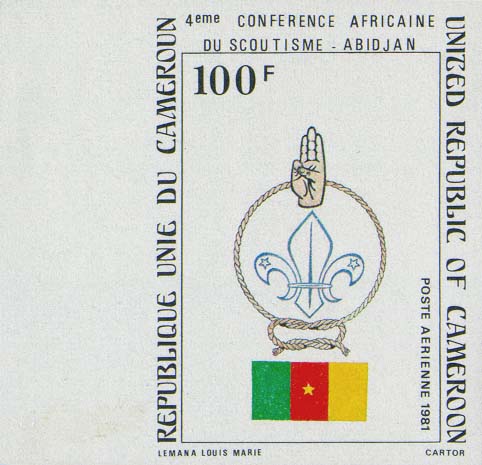
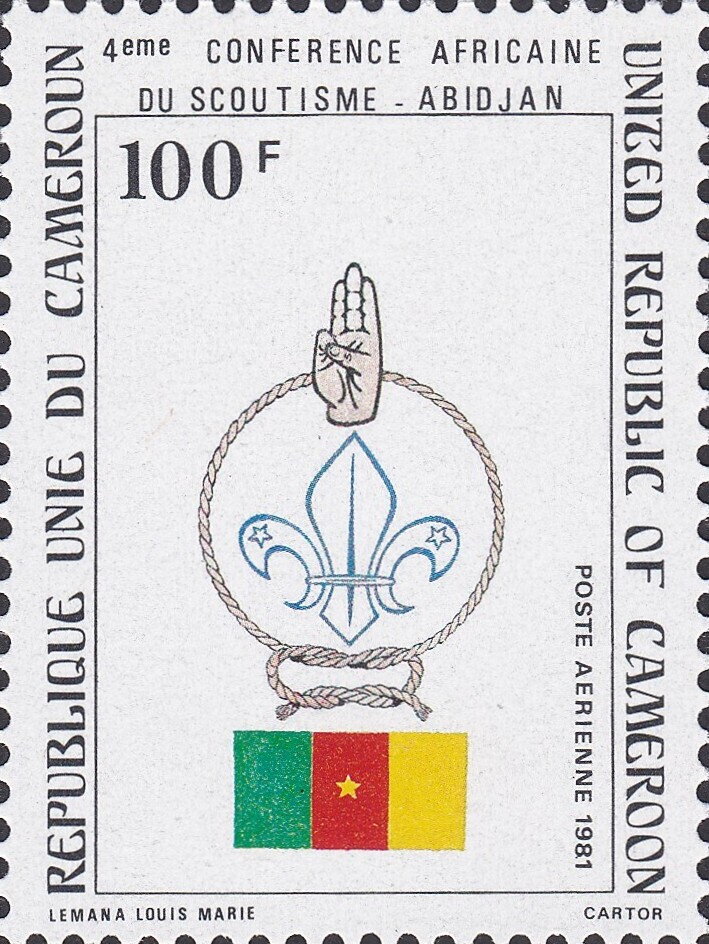
White ground. Lettered 100F. The World Scout fleur-de-lis sits in a rope circle with a three-finger Scout salute above it and the Cameroon flag below. Inscribed RÉPUBLIQUE UNIE DU CAMEROUN, UNITED REPUBLIC OF CAMEROON, 4eme CONFERENCE AFRICAINE DU SCOUTISME - ABIDJAN, POSTE AERIENNE and 1981. Signed LEMANA LOUIS MARIE and CARTOR. Imperforate.
Series history
The United Republic of Cameroon issued two airmail commemoratives at Yaoundé on 5 October 1981 for the 4th African Conference of Scouting in Abidjan. Each stamp is lettered RÉPUBLIQUE UNIE DU CAMEROUN, UNITED REPUBLIC OF CAMEROON, 4eme CONFERENCE AFRICAINE DU SCOUTISME - ABIDJAN, POSTE AERIENNE and 1981, and signed LEMANA LOUIS MARIE and CARTOR.
The 100 francs, on a white ground, shows the World Scout fleur-de-lis in a rope circle with a three-finger salute above it and the Cameroon flag below.
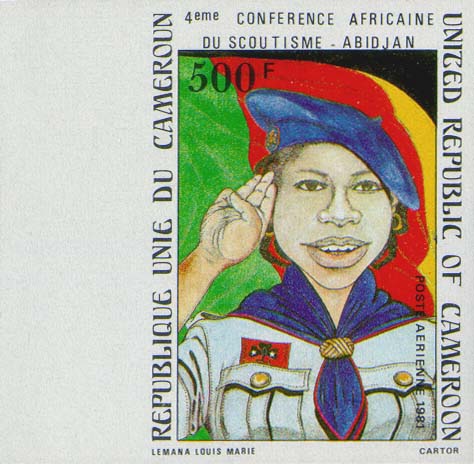
The 500 francs is a portrait of a Scout in a blue beret, white shirt and blue neckerchief giving the Scout salute, against the green, red and yellow of the Cameroon flag.
Louis-Marie Lemana designed the stamps. Cartor printed them by offset lithography, about 30 × 40 mm, in panes of 25. Sources give the perforation as comb 12½ or 13 × 12½. Both values exist imperforate.