
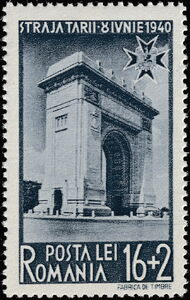
Triumphal arch in Bucharest — 16 + 2 L

Piece details
Identity
- Piece codeStamp code YYYY.ENT.SS-PP — series code plus stamp order (e.g. 1900.CGH.01-02).
1940.ROU.01-08- SeriesThe set this stamp belongs to.
- Straja Țării — landmarks of Romania
1940.ROU.01· piece 8 of 8 - EntityPostal authority that issued the stamps (country, territory, or historical entity).
 Romania (ROU)
- Year / date
- 1940-06-08
- Face valueDenomination on the stamp; +n is a charity surcharge when present.
- 16 + 2 L
- Format
- Stamp
- TypeIssue kind. Charity issue = postage + voluntary surcharge (e.g. 6+4), not an overprint.
- Charity issue
- Colors
- Dark blue-grey
- CollectionIn collection if you have it; Purchased if it is bought but not yet received (do not buy again); Wanted otherwise.
- ✓ In collection
Production
- Printer
- Fabrica de Timbre, Bucharest
- PerforationsHole gauge between stamps (e.g. 12, 13½). Higher ≈ finer.
- Comb 14 × 14½
- Printing
- Photogravure
- Size
- 26 × 42 mm
Catalog numbers
- DomfilDomfil thematic catalog number (scouting).
- 940.24
- ScottScott catalog number (Americas).
- RO B134
- MichelMichel catalog number (Europe / DE).
- RO 638
- YvertYvert & Tellier catalog number (FR).
- RO 610
- Stanley GibbonsStanley Gibbons catalog number (UK / Commonwealth).
- RO 1451
Notes
Triumphal arch in Bucharest, with STRAJA ȚĂRII · 8 IVNIE 1940 lettered up the side and the organisation's star at the corner. Watermark crown and monogram of King Carol II, multiple. Domfil 940.24. Romanian catalogue 141h. Print run 100,000. Valid until 1 November 1940.
Series history
Romania issued eight semi-postals on 8 June 1940 in aid of Straja Țării. Domfil catalogues the set as 940.17/24 and enters every value under the heading Escultismo — Scouting.
Straja Țării, the Sentinel of the Country, is the reason the set belongs in a Scout catalogue, and the reason is not a happy one. On 24 January 1937 King Carol II dissolved the Cercetașii României, the Romanian Scout association, and put Straja Țării in its place as the single state organisation for the young. Membership was compulsory: boys from seven to eighteen, girls from seven to twenty-one. Where the Scouts had been voluntary, Straja Țării was paramilitary, patronised by the king and built to keep the Iron Guard away from Romanian youth. These stamps are the philately of a movement that replaced Scouting rather than expressing it.
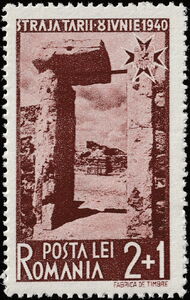
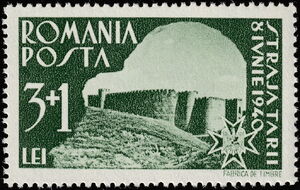
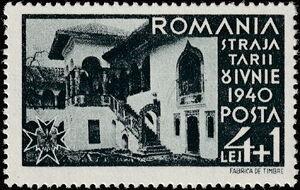
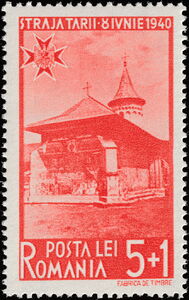
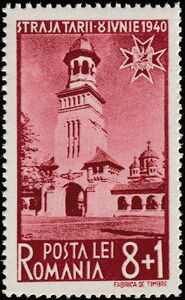
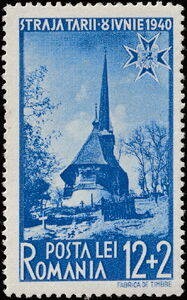
The date on every stamp, 8 June 1940, is the tenth anniversary of Carol's return to the throne, and the designs turn away from the organisation itself to the country it claimed: the Kazan gorge of the Danube, the Roman ruins at Histria, the fortress of Cetatea Albă, the monastery of Horezu, the painted church of Voroneț, the coronation church at Alba Iulia, a wooden village church of Maramureș, and the triumphal arch in Bucharest. Each carries STRAJA ȚĂRII and the date up one side with the organisation's star at the corner.
All eight were printed in photogravure at the Fabrica de Timbre in Bucharest, on paper watermarked with the crown and monogram of King Carol II, each in a run of 100,000, and all expired for postage on 1 November 1940 — by which time Carol had lost Bessarabia, northern Transylvania and, in September, his throne. Further references are Michel RO 631–638, Scott RO B127–B134, Yvert RO 603–610, Stanley Gibbons RO 1444–1451 and, in the Romanian catalogue, 141a–h.